Bridge from the previous article
If AI has to adapt to real medicine, the first step is to look at where that medicine gets stuck.
Previous reading: “Five questions before putting AI to work in a hospital”
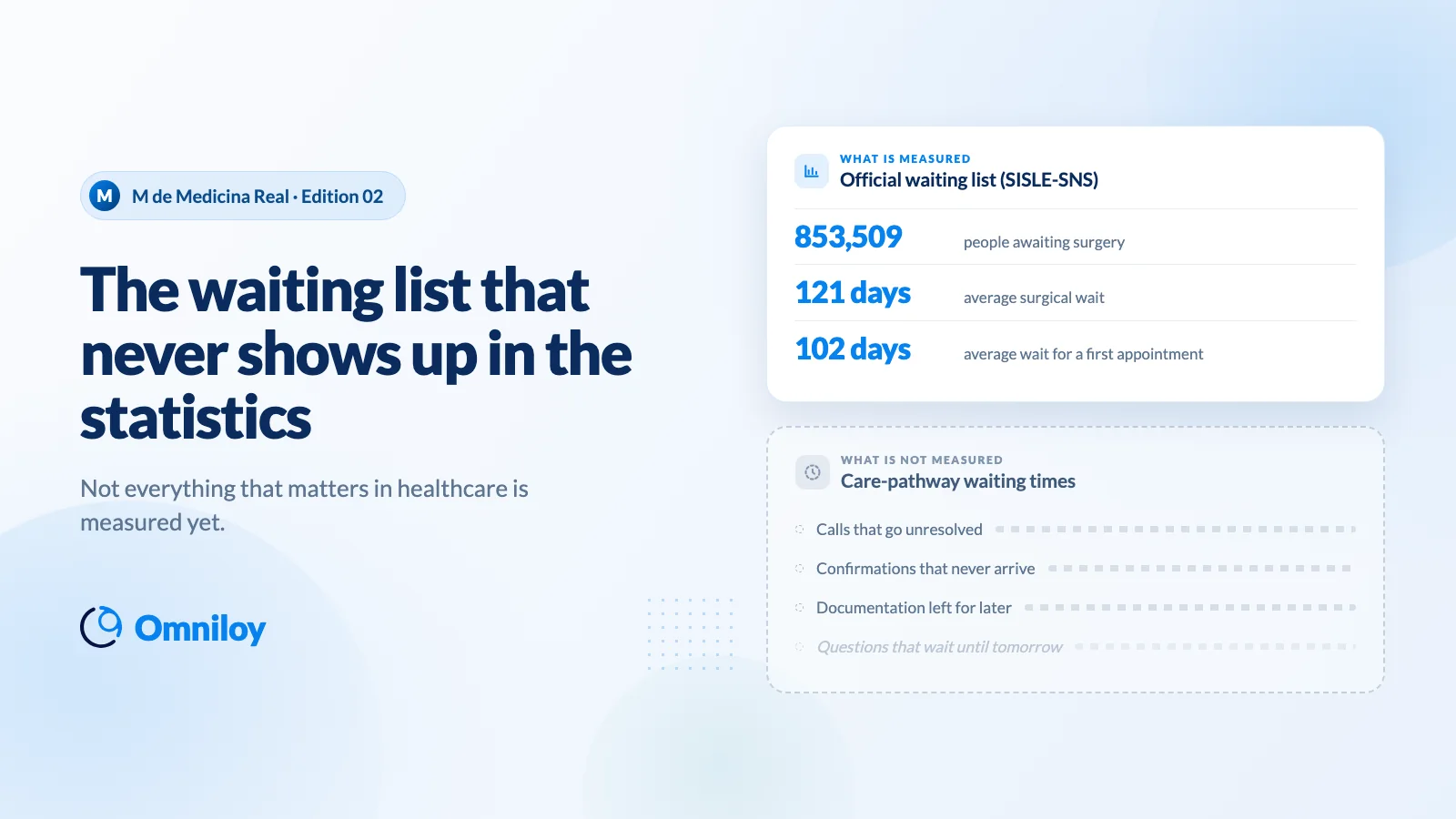
As of 31 December 2025, there were 853,509 people on the structural surgical waiting list in the Spanish National Health System. The average wait was 121 days. For a first specialist outpatient appointment, the average wait was 102 days; 61.5% of patients had been waiting more than 60 days; in this edition the indicator also includes those still without an assigned appointment who had already passed that threshold.
These are stark figures. And precisely for that reason, they deserve a careful reading.
At a glance
- 853,509people awaiting surgery
- 121 daysaverage surgical wait
- 102 daysaverage wait for a first appointment
- 61.5%of appointments beyond 60 days
A waiting list is not just a number. It is a person who has received an indication and has not yet been seen. It is a procedure that cannot be scheduled yet. It is a system that has to order resources, priorities and needs that do not always fit into a calendar.
But there is a second waiting list. It does not appear in the Ministry's tables. It has no rate per thousand inhabitants. And yet it forms every morning at admissions, on the switchboards, in task inboxes and at the end of the last appointment of the day.
It is the wait of someone who calls to change an appointment and cannot get it resolved. Of someone who needs to confirm a test and gets an answer when they can no longer take the call. Of the professional who finishes seeing patients and starts a second working day: completing notes, organising information, correcting fields, coding. Of the person who leaves an appointment with a practical question and discovers they will have to wait until tomorrow's opening hours to ask it.
These are not clinical waiting lists in the strict sense. They should not be confused with them. But they are care-pathway waiting times. And they have a cumulative effect: they add friction to care that, for patients and professionals alike, is rarely experienced as isolated episodes.
What the figures do tell us
The public statistics of the National Health System's Waiting List Information System (SISLE) define clearly what they measure. The structural surgical list includes patients due to undergo a procedure whose wait is attributable to the organisation and the resources available; the outpatient list refers to those awaiting a first specialist appointment.
That precision matters. Measuring well avoids easy headlines and makes it possible to compare how the system evolves against common criteria.
The December 2025 report also shows relevant differences by specialty. For first appointments, the average wait was 132 days in Orthopaedics, 127 in Dermatology, 109 in Neurology and 107 in Ophthalmology and Otolaryngology. On the surgical list, Orthopaedics had 200,584 patients waiting and an average wait of 137 days.
Official data
The SISLE-SNS report does not measure “all” waiting in healthcare: it measures, specifically, the structural wait for a procedure and for a first specialist appointment. That distinction is key to interpreting the figures.
This is not a statistical footnote: these are figures that force us to look at complete processes. Because the delay the system measures is critical, but it does not cover every place where time is lost.
The wait starts before you join the list
Think of an appointment cancelled at short notice. It can free up a valuable slot, but only if the centre is able to detect it, reach the right person and handle the change quickly. If the process depends on consecutive phone calls, limited hours and manual tasks, that slot may go unfilled even though patients are waiting.
Or think of an appointment that went well from a clinical point of view, but leaves behind unstructured information, pending administrative actions or follow-up that has to be triggered later. The care has already happened; the work has not necessarily.
This is where we usually go wrong when we talk about efficiency. The alternative is not asking professionals to move faster, nor turning the patient into the manager of their own pathway. It is identifying the repetitive, predictable and protocol-driven tasks that today consume human attention without needing it in every case.
Core idea
This is not about replacing clinical judgement. It is about reserving it for where it is genuinely essential.
The question is not “where do we put AI?”
In the previous article we argued that healthcare AI should not force teams to work differently in order to fit a tool. It should adapt to real medicine. This is the practical consequence of that idea: before talking about technology, you have to observe where time is being lost along the care pathway.
When a healthcare organisation thinks about artificial intelligence, it is easy to start with the technology: which tool to bring in, which chatbot to switch on, which process to automate. That is the wrong order.
The useful question is a different one:
A question to open the conversation
At what point in the pathway are we making someone wait without that wait adding any value?
Sometimes the answer will be a confirmation call. Sometimes, preparing information ahead of an appointment. Sometimes, the documentation that comes afterwards. Sometimes, the administrative questions that arrive out of hours. And often it will not be a single problem, but a chain of small frictions that nobody had ever put together on the same table.
That diagnosis changes the kind of solution required. Instead of adding yet another platform, it calls for designing a flow that integrates with the calendar, the HIS, the communication channels and the centre's protocols. It also calls for setting clear limits: what a system can resolve autonomously, when it must ask for confirmation and at what point it must escalate immediately to a person.
Responsible automation is not about always answering. It is about knowing when it should not.
Time freed up is not an abstract concept
A well-integrated administrative AI can handle confirmations, rescheduling or frequent questions 24 hours a day, within a framework defined by the centre. A clinical copilot can turn a conversation into a structured note and ease the documentation and coding work that follows.
That does not remove the complexity of care, nor does it resolve a surgical waiting list on its own. It would be irresponsible to promise that.
What it can do is reduce the volume of low-value tasks that compete with care. It can help an admissions team spend more time on a complex exception and less on a repeated task. It can stop necessary documentation from becoming night work. It can help someone find an answer or a route to contact without starting another round of phone calls.
And it can be measured. Not with grand claims, but with concrete indicators:
- Contacts resolved and response time
- Appointments recovered after a cancellation
- Calls answered and handled
- Administrative tasks offloaded
- Documentation quality
- Incidents escalated correctly
- Patient and team satisfaction
The waiting list that deserves a conversation
Official lists are essential because they make visible a problem that cannot be trivialised. But more accessible healthcare is not built only when an average number of days comes down. It is also built when the patient does not have to chase an answer, when a calendar makes better use of its capacity and when a professional can devote their attention to what requires experience, empathy and clinical judgement.
Not everything that matters in healthcare is measured yet. But everything that makes people wait without adding value deserves to be reviewed.
Real medicine is not improved by a generic AI promise. It is improved by identifying a specific friction, integrating into how the centre works and demonstrating that the time recovered goes back into care. That is Omniloy's starting point.
Which wait at your centre could we avoid tomorrow?
Sources
Ministry of Health. Waiting List Information System of the Spanish National Health System (SISLE-SNS), position as of 31 December 2025.
Publication page: sanidad.gob.es · Waiting lists
Indicators and methodology report: LISTAS_PUBLICACION_Dic_2025.pdf
Editorial note: the data is presented with its official cut-off date and refers to the indicators defined by SISLE-SNS. It is not extrapolated to other care-pathway waiting times.