At Omniloy we believe research is key to developing artificial intelligence that is useful, safe and applicable to everyday healthcare. That is why we recently presented the work “SofIA: AI Clinical Companion for Real-Time Documentation and Decision Support” at the AAMAS Conference 2026.
The paper, developed by Leire Villarroya Martínez, Enrique Alcázar Garzas and Stella Heras, analyzes how AI-based clinical assistants can reduce the administrative burden on healthcare professionals and support decision-making in real time.
In a healthcare professional's day-to-day, every consultation means handling a growing volume of information. Digitalization has increased access to data, but it has also exponentially increased the amount that professionals must manage each day.
More than a virtual assistant
From automating administrative tasks to analyzing medical images, artificial intelligence has been gaining ground in healthcare for years. Yet the real transformation lies not only in adopting new technologies, but in integrating them usefully into clinical practice.
Clinical assistants therefore propose a new way of understanding technological support. The goal is not to add one more tool, but to simplify processes, reduce the administrative burden and let professionals dedicate more time to what really matters: patient care.
AI that supports the healthcare professional
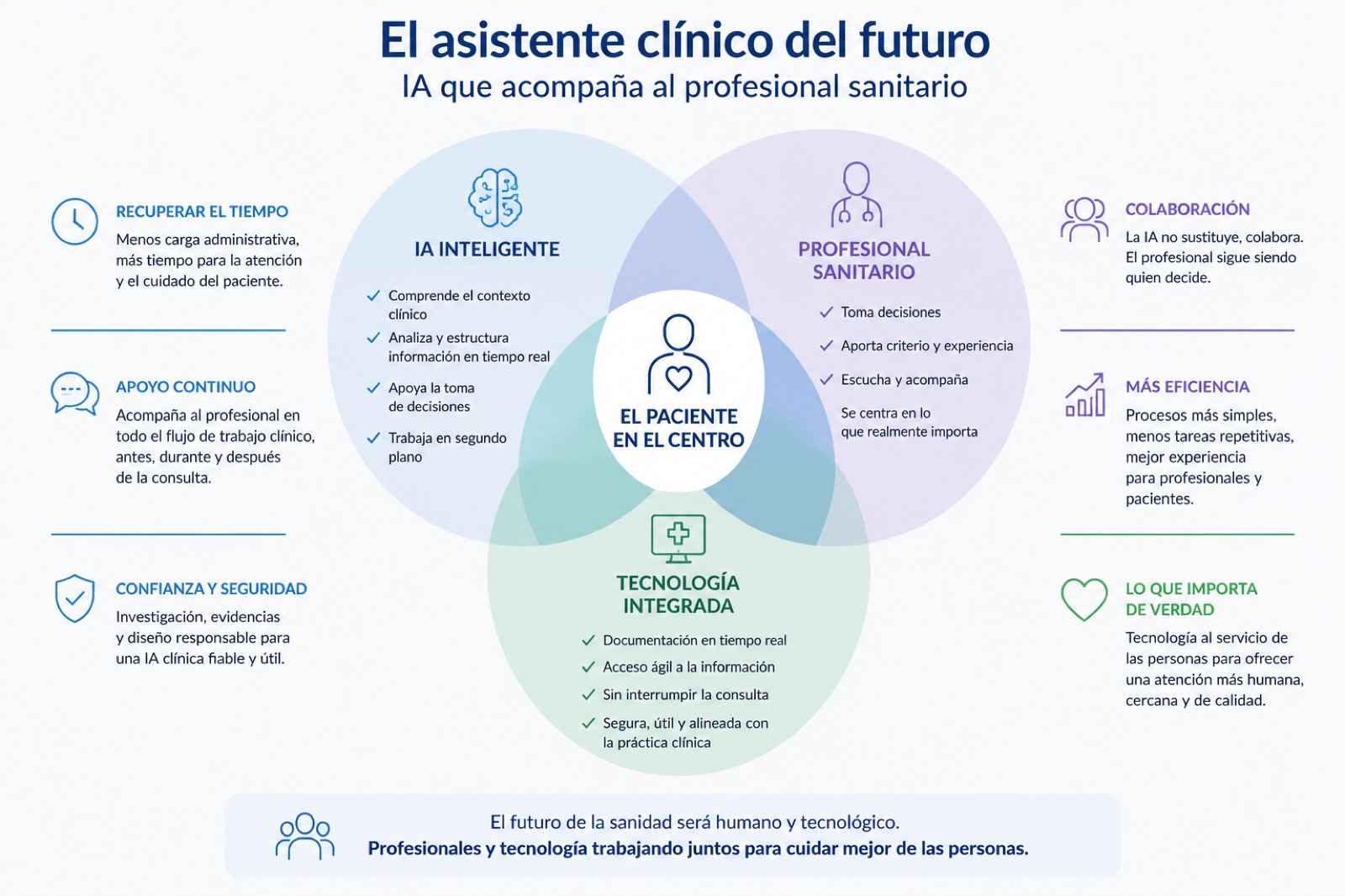
More than offering assisted answers, the evolution of this technology is giving way to a new generation of clinical assistants designed to “accompany” the professional. Artificial intelligence stops playing a secondary role and becomes continuous support within the clinical workflow.
The goal is not to automate or replace, but to improve the efficiency and confidence of clinical staff. When AI takes on repetitive, administrative tasks, professionals can focus on what is important: listening to, supporting and caring for people.
The real value of a clinical system lies in giving the professional the right information at the right time. Not in deciding for them.
The consultation of the future begins in real time
For a clinical assistant to deliver real value, it is not enough to transcribe a conversation or retrieve information from the medical record. Its usefulness depends on its ability to understand the clinical context and offer support without interrupting the natural flow of the consultation.
Real-time clinical documentation marks a paradigm shift. While the professional keeps the normal flow of the conversation with the patient, artificial intelligence analyzes, structures documentation, organizes access and eases the process.
Understand, support and simplify: the three capabilities that define the new generation of assistants.
Real-time clinical documentation
While the professional keeps the natural flow of the conversation, the AI analyzes, structures documentation, organizes access and eases the process.
Understands the clinical context
Transcribing or retrieving record information is not enough. Its usefulness depends on understanding the clinical context and offering relevant support without interrupting the consultation.
The professional keeps deciding
Technology steps into the background and does not steal the spotlight. Rather than replacing processes, it takes on the tasks that consume time and add little clinical value.
Research for more useful clinical AI
Developing clinical assistants that integrate naturally into healthcare practice requires more than technological advances. It also needs research that helps us understand how to apply artificial intelligence safely, usefully and aligned with the real needs of professionals.
The work “SofIA: AI Clinical Companion for Real-Time Documentation and Decision Support”, presented at the AAMAS Conference 2026, explores how an AI-based clinical assistant can combine real-time documentation and decision support to fit into the care workflow without adding complexity. Beyond academic recognition, this research helps bring innovation closer to hospitals and healthcare centers.
A new way of collaborating with technology
The evolution of artificial intelligence in healthcare is not only about automating processes. Its real potential lies in developing tools able to collaborate with professionals, understand the clinical context and offer support where it truly makes a difference.
Intelligent clinical assistants do not come to replace professionals' judgment, but to strengthen it. By integrating naturally into clinical practice, they reduce the administrative burden, ease access to information and give back time for what really matters: patient care.
The future of healthcare will remain in the hands of doctors, nurses and professionals. The difference is that they will increasingly have technologies able to work by their side, integrated naturally into their daily practice.
Want to know how we are developing the next generation of clinical assistants? Talk to our team.