Every week there's a new headline. That AI is going to replace doctors, that machines diagnose better than people, that in ten years consultations will be conversations with an algorithm… The debate is loud, and we get it: “AI is going to replace the doctor” sells better than “AI is going to save the doctor forty minutes of paperwork”.
But while the debate makes noise, reality moves forward quietly. According to the American Medical Association's 2026 survey, 81% of physicians already use artificial intelligence in their practice, more than double the figure in 2023. The question is no longer whether AI will enter healthcare. It's on what terms.
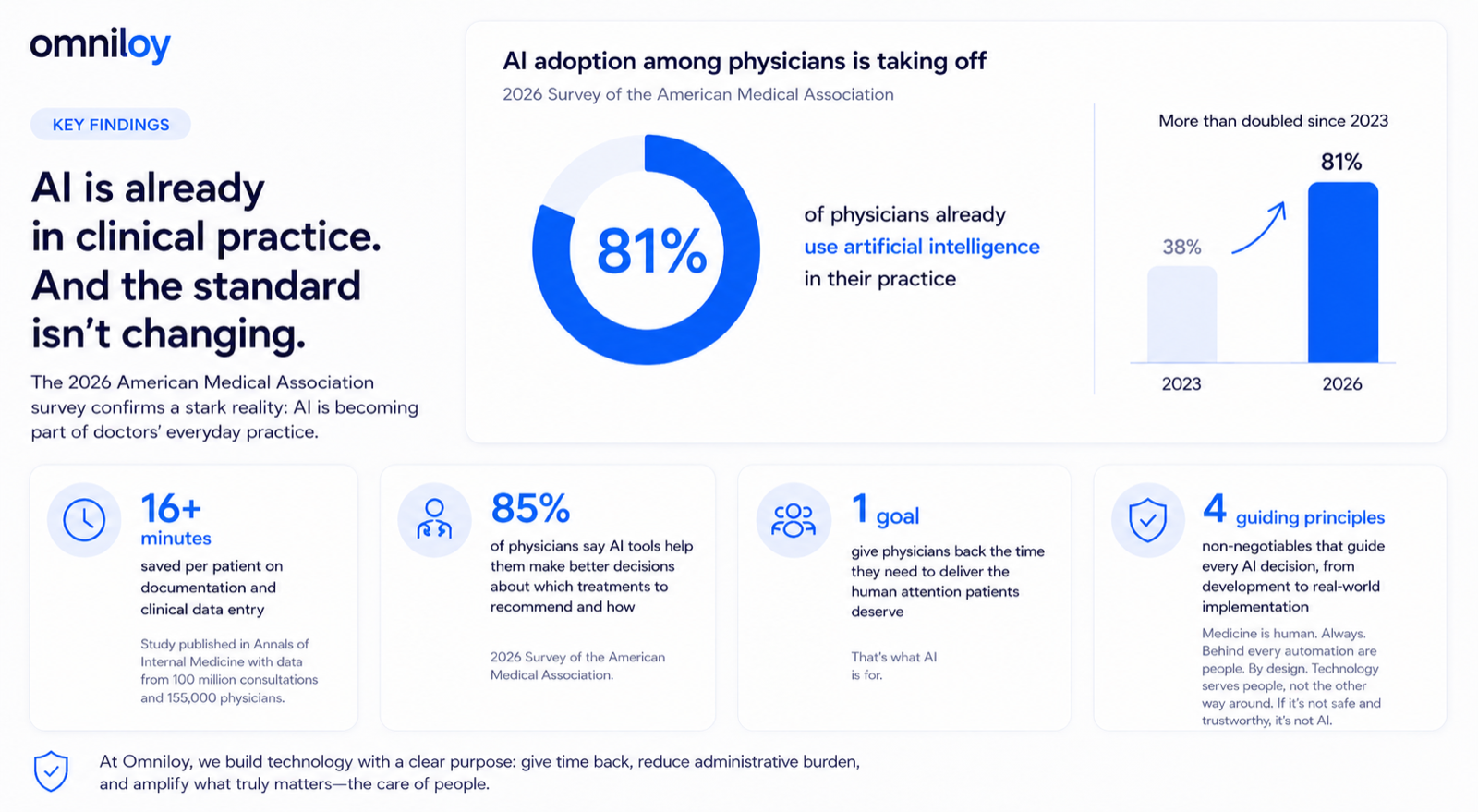
Source: American Medical Association 2026 survey.
And that's where there's a question we get asked often, in hospitals, at conferences and inside the team too: with a technology that changes every few months, what stays the same?
The AI models we use today look nothing like the ones from a year ago, and they won't look like next year's. What doesn't change are the criteria we use to build. And these are non-negotiable.
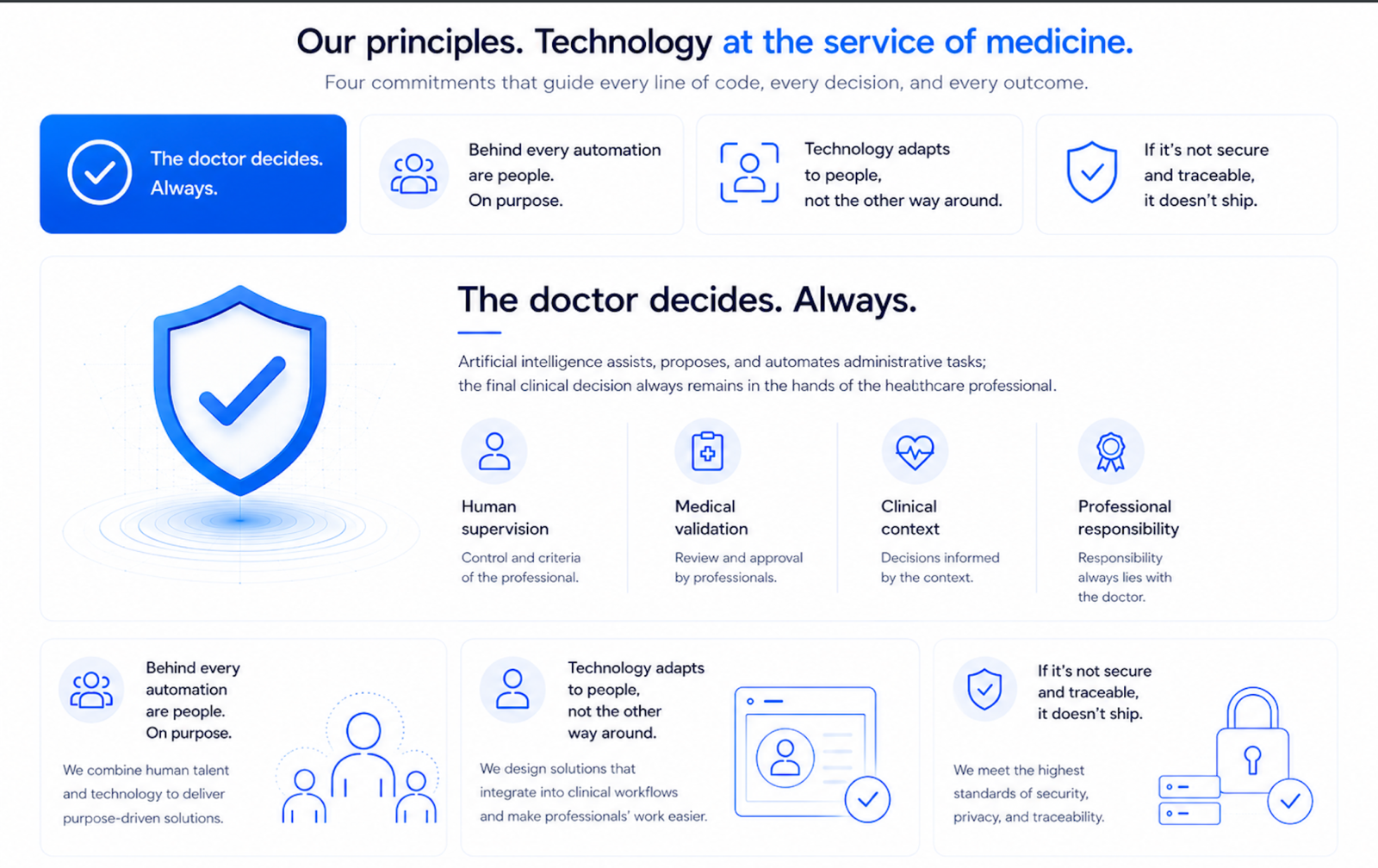
The doctor decides. Always.
The cost of clinical documentation has been measured: a study published in Annals of Internal Medicine, with data from 100 million consultations and 155,000 physicians, put the time spent on the electronic health record at more than 16 minutes per patient. SofIA exists to recover that time: it listens to the consultation, structures the information, drafts the clinical note, proposes the coding. And there it stops. Nothing enters the health record without the professional validating it. They can edit it, correct it or discard it, and everything is traced.
This is not a technical limitation we hope to overcome one day. It's a design decision. AI can prepare the ground better and faster than ever, but there is something that isn't delegated. If tomorrow a more powerful version of our models let us skip that step, we still wouldn't do it.
And we're not the only ones who see it this way: in the same AMA survey, 85% of physicians ask to take part in the decisions about which AI tools are adopted and how. Professionals don't want to be replaced or have decisions made for them. They want to be in charge. We build for that.
Clinical judgment isn't delegated. AI prepares the ground; the decision belongs to the doctor.
Behind the automation there are people. On purpose.
MarIA answers calls and messages at any hour, confirms appointments, resolves frequent questions. And when the situation calls for it —because the case is complex, because the person asks for it, because something doesn't add up—, it escalates to a human. That escape route isn't a plan B: it's part of the system.
Automating the repetitive doesn't mean removing people from the equation. It means a call center team stops chasing missed calls and can devote itself to what genuinely needs human attention.
The question we ask isn't “how much can we automate?”, but “what deserves a person's time?”.
Technology adapts to people, not the other way around
A few months ago, at one of the hospital groups we work with, we spotted something no technical manual captures: in Dutch, not addressing someone formally can come across as disrespectful. The voice assistant wasn't using the right register with Dutch patients. It was fixed in a day.
It's a small detail, and that's precisely why it matters to us. A technology that forces the patient to adapt —to another language, another register, an app they don't know how to use— is only solving the problem halfway. That's why our agents speak the patient's language, and that's why they work over phone or WhatsApp, without asking anyone to learn anything new.
If it isn't secure and traceable, it doesn't ship
In healthcare, “move fast and break things” doesn't cut it. Every response from our agents has to be explainable: what information it used, where it came from, who validated it. If something can't be traced, it doesn't reach production. It's that simple.
That's why we've chosen the long road: getting certified, audited and held to the most demanding regulatory frameworks in the healthcare sector. Not because it looks good on the website, but because security and regulatory compliance aren't a formality you clear at the end: they're constraints we design with from day one.
We'd rather have a hospital trust us five years from now than impress it for five minutes.
Technology passes. The criteria stay.
We don't know exactly what AI will look like two years from now. Nobody does, and anyone who says otherwise is selling something. What we do know is the criteria with which we'll adopt it: the doctor decides, there's always a person behind it, technology adapts to people, and nothing ships unless it's secure and traceable.
In the end, the answer to the big debate is simpler than it seems. AI isn't here to replace the doctor. It's here to give back something the system had taken away: time to look at the patient. And that, whatever changes in the technology, is what won't change at Omniloy.
Want to know how we put these principles to work in your health center? Get in touch.