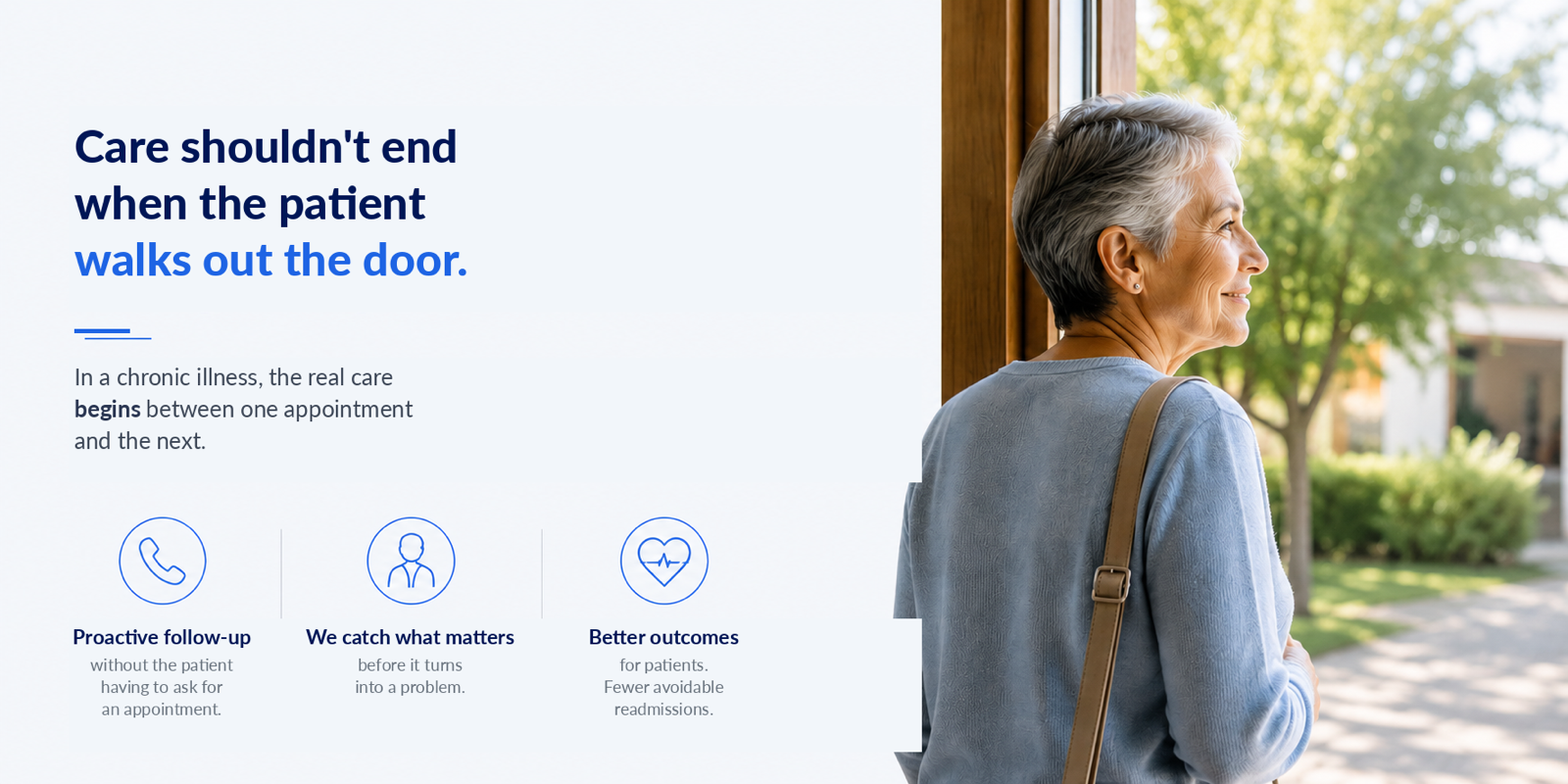
What happens to a chronic patient between one appointment and the next? Almost always, the honest answer is: we don't know. They leave the consultation with a new plan, a prescription and an appointment six months out. And from there, silence. For half a year, the hospital hears nothing from them until they sit down in the consulting room again and recount, from memory, how it went.
That gap between visits is one of the most fragile points in all of healthcare. And it's exactly the one we watch worst.
The outcome is decided outside the consulting room
We tend to think the important part happens inside the consultation: the diagnosis, the treatment adjustment, the clinical decision. But in a chronic illness, much of the outcome is settled outside, at home, during the months when no one is watching.
That's where the patient decides, every morning, whether to take the pill. Where they notice a side effect and don't know if it's normal or if they should flag it. Where they stop the medication halfway because they already feel better, or because they never quite understood what it was for. And they do it alone, with no one to ask without having to book an appointment.
The data puts numbers to that silent drop-off:
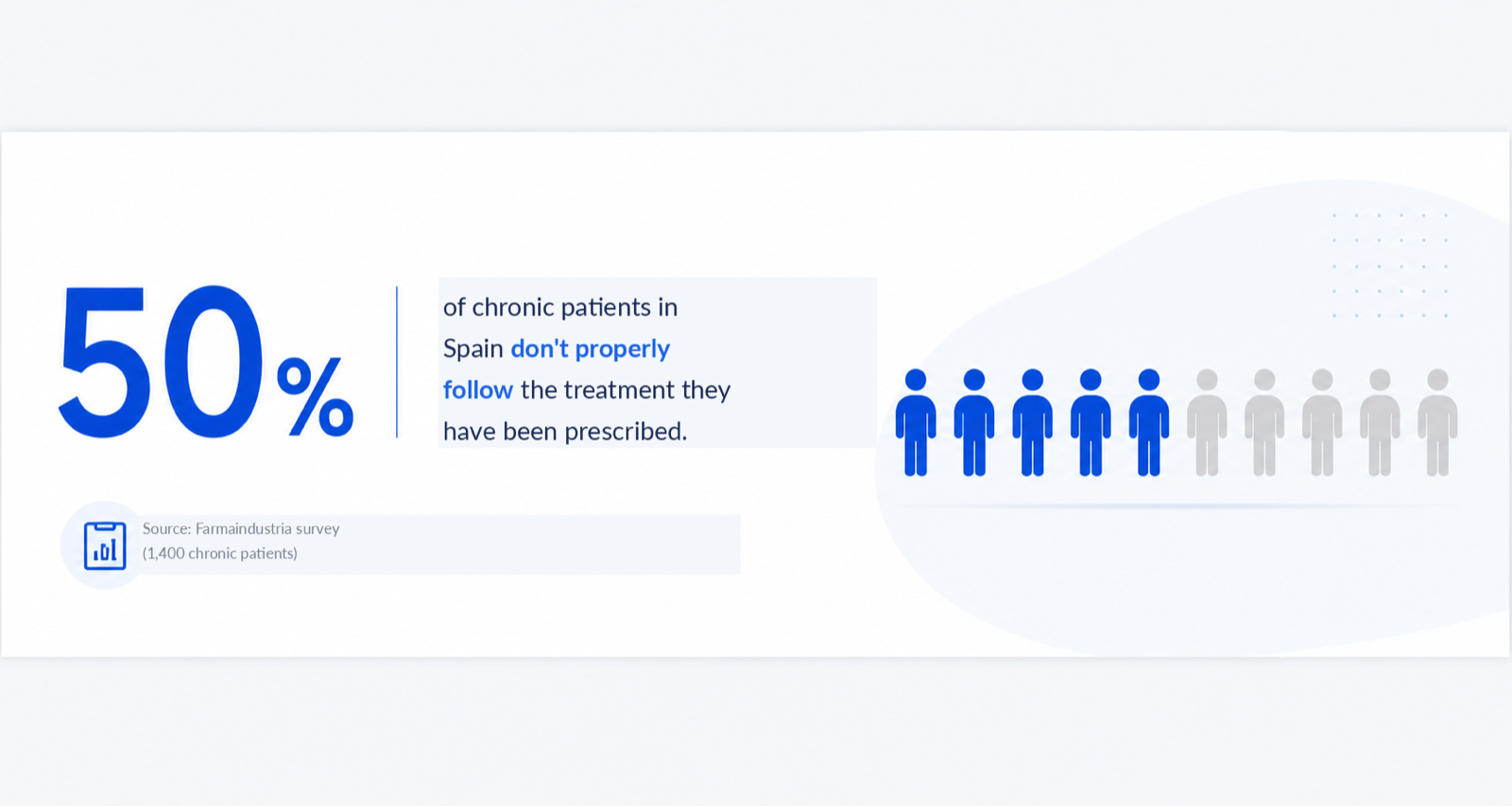
Source: national Farmaindustria survey of 1,400 chronic patients.
In Spain, only half of chronic patients properly follow the treatment they've been prescribed. Behind that figure lie avoidable readmissions and patients who worsen in silence between one review and the next.
A national survey commissioned by Farmaindustria of 1,400 chronic patients confirms it. Half. Not because they don't care, but because between one appointment and the next there's nothing holding them up.
Follow-up doesn't fit the model
The logical question is: why isn't follow-up done? And the answer isn't a lack of will, but a lack of hands.
Calling every chronic patient to ask how they're doing, whether they tolerate the medication well, whether they have questions, whether they need to bring the review forward, is simply unfeasible with a hospital's resources. A nurse who spent the whole day calling one by one would barely reach a handful a day. Multiply that by the hundreds or thousands of chronic patients at a center and the math doesn't work. So it isn't done, and follow-up is reduced to the appointment every six months.
It's not negligence. It's a problem of scale: good intentions aren't enough when the volume overwhelms the people available.
This is where MarIA comes in
This is the gap we work on at Omniloy with MarIA Outbound: instead of waiting for the patient to call or for the next appointment to arrive, it's MarIA who reaches out to proactively follow up with chronic and post-operative patients.
On each call it gathers how the patient is progressing and, drawing on a risk assessment, identifies the situations that need attention and prioritizes them for the medical team. The professional reviews the clinical status, the change over time and the patient's answers, and decides the actions. MarIA prepares and organizes; the clinical decision stays with the doctor.
MarIA prepares and organizes; the clinical decision stays with the doctor. The routine resolves itself; whatever needs a human reaches a human.
The conversation is in natural language, over phone or WhatsApp, without asking the patient to learn any new app. And when the situation calls for it, it's handed off to a professional.
The idea isn't to replace the relationship between the patient and their medical team, but to keep it alive during those months when today it doesn't exist. To turn six months of silence into a thread that never breaks.
What you gain when the gap is filled
A chronic patient who is accompanied between visits is one who is less likely to be left alone with their doubts, and whose warning signs can be caught earlier, instead of waiting for them to show up in the consulting room six months later.
And for the hospital, the advantage is scale: being able to keep that contact with far more patients than any staff could call one by one by hand, and to prioritize care according to the risk detected.
In a chronic illness, care shouldn't end when the patient walks out the door. That should be exactly when it begins.
And for that you don't need more staff, but a way of being present that reaches everyone, not only whoever picks up the phone in time.
Want to see how MarIA can accompany your chronic patients between visits? Talk to our team.