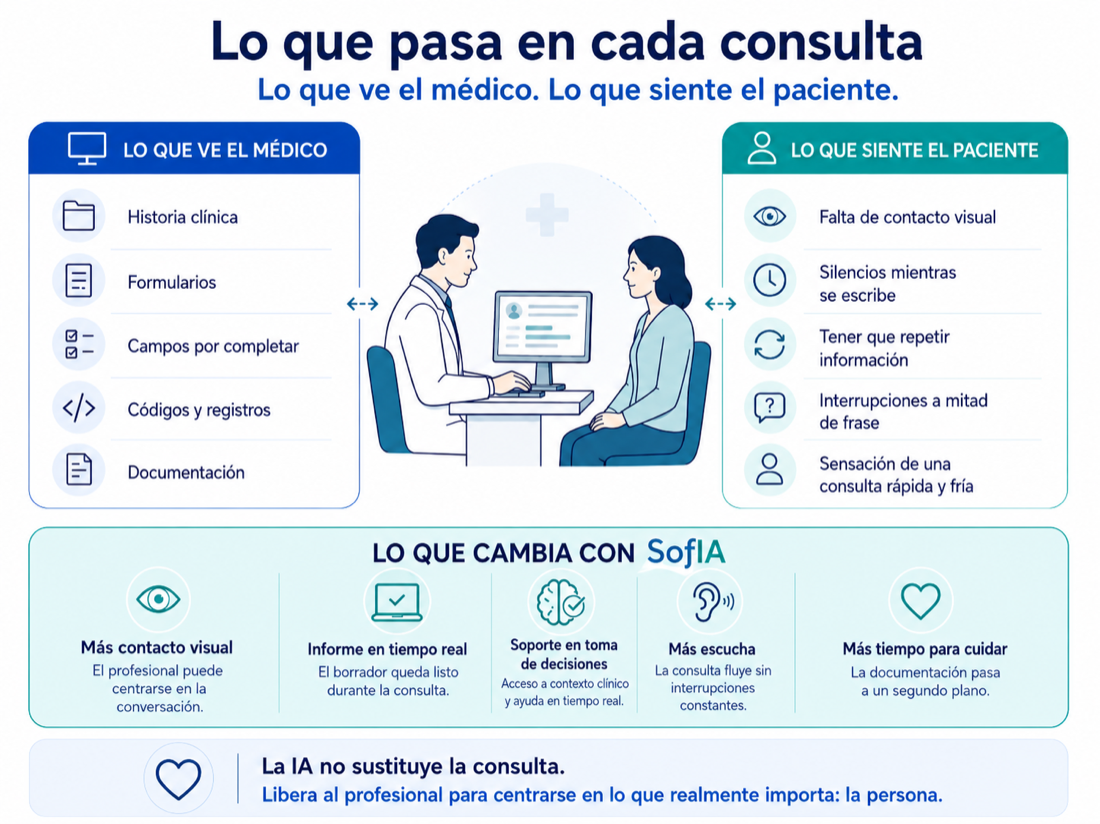
There is a scene that repeats in thousands of consultations every day and almost never shows up in any satisfaction survey: the patient talks, and the doctor looks at the screen.
It's not that they aren't listening. It's that they can't afford to stop typing. Whatever they don't note down now they will have to reconstruct from memory later, between this consultation and the next, with the hallway already full of people waiting. So they look at the computer, not at the person in front of them. And they almost always do it with the best of intentions: to not lose a single detail, to not get the report wrong afterwards.
What is lost between one sentence and the next
At Omniloy we have spent a long time thinking about this, not as a product metric but as something much simpler: what it feels like on the other side of the desk. When we have discussed it with the clinical teams already working with us, the answer is almost always the same. Patients don't remember the diagnosis word for word. They remember whether the doctor looked at them, whether they felt someone was truly listening, or whether the consultation went by with attention fixed somewhere else.
There is one figure that made us think harder than expected, from an eye-tracking study of a hundred medical consultations:
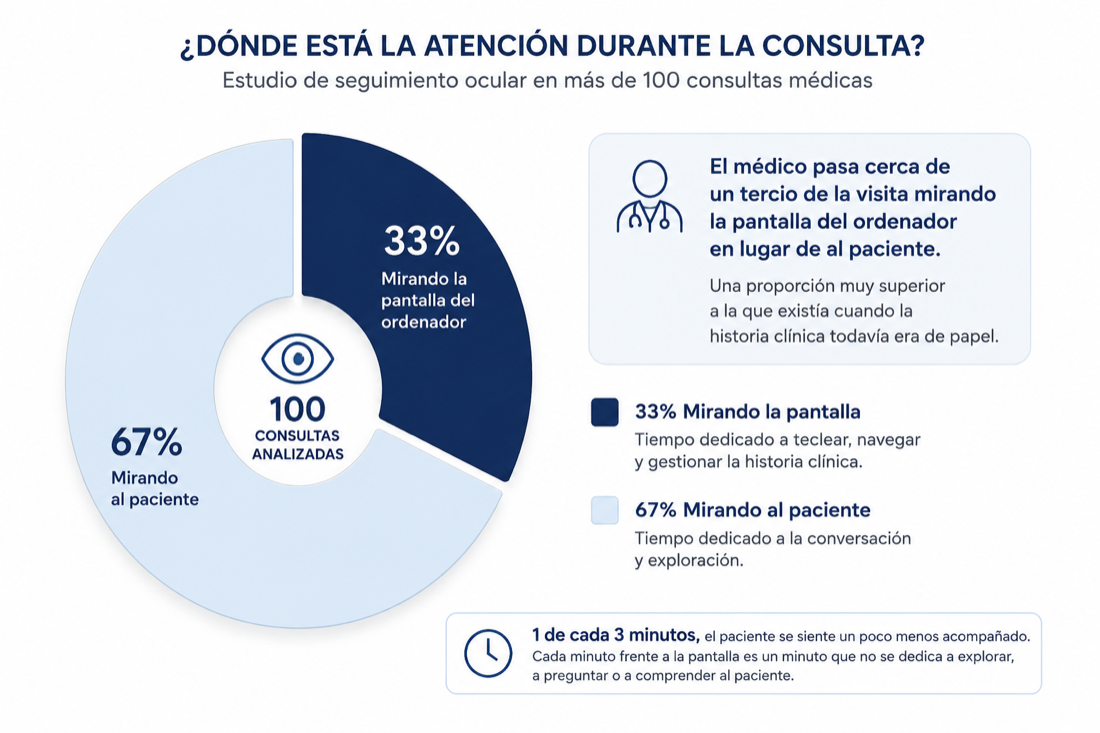
Source: Somos Medicina (11 February 2014). “Do doctors spend too much time looking at the screen?”
A third is no minor detail. It means 1 in every 3 minutes in which the patient feels a little less accompanied, and in which the doctor, however much they want to be fully present, cannot be. And it's not just a matter of perception: every minute spent typing is a minute not spent examining, asking twice when something isn't clear, or simply letting the patient finish the sentence without anyone rushing on to the next box on the form.
What the patient really perceives
No patient probably leaves the consultation thinking: “my doctor spent a third of the time looking at the screen”. But they do clearly perceive the consequences of that time.
They notice it when they are cut off mid-sentence because the professional needs to finish writing the previous thing. They notice it in those silences when the doctor types and the patient isn't sure they are still fully listening. They notice it when they have to repeat something they had already explained, because it wasn't captured the first time. And they notice it, above all, in that hard-to-measure but very recognizable feeling: the consultation lasted as long as always, but it felt faster, colder and less accompanied.
It is not just about time in front of a screen. It is about presence, listening and the quality of the clinical bond at a moment when the patient needs to feel cared for, not simply recorded.
How we are solving it with SofIA
SofIA is born from a very specific idea: “AI shouldn't be one more tool the professional has to learn to use. It should live inside what the doctor already does, without asking them to choose between listening and documenting,” says Mar Pujadas, CEO and co-founder of Omniloy. The conversation is transcribed and structured on its own, in real time, with the draft report ready even before the patient gets up from the chair. Not because the machine listens better, but so the doctor can devote those minutes to the one thing that truly cannot be automated: looking at the person in front of them.
We don't do it because technology is more important than the doctor. We do it exactly the other way around, because we believe the clinician and the patient are the most important thing in that room, and that it deserves to be shown without having to choose between listening and documenting. That is why SofIA's design starts from one condition we do not negotiate: the doctor reviews, edits and validates every report before it is recorded. The AI proposes. The decision is always human.
In the end, it all comes down to one thing
So if someone asks us what Omniloy does, lately we answer something different from “AI for hospitals”. We give the patient back something they should never have lost: their doctor's gaze. And that, more than any product metric, is what we truly care about measuring.
Want to see how SofIA gives the doctor's gaze back to the consultation? Talk to our team.