Imagine this situation. A patient calls her hospital because she has an appointment on Thursday, but her work shift has changed. She needs to move it to another day, preferably in the afternoon.
A friendly voice answers:
- Virtual assistant“Hello, I’m the hospital’s virtual assistant. How can I help you?”
- Patient“I need to change my appointment on Thursday.”
- Virtual assistant“Of course, I’ll put you through to the right department.”
And the hold music begins. The artificial intelligence has understood exactly what she needed. It has identified her intent and directed her to the right department. But the patient still does not have a new appointment.
From “press 1” to “tell me what you need”
For years, IVR (Interactive Voice Response) systems have helped hospitals and clinics organise large volumes of calls through menus and predefined options.
“Press 1 for appointments. Press 2 for information. Press 3 to speak to an operator.”
These systems have been useful for routing calls and, with the right integrations, can also carry out certain operations. Conversational AI agents, however, open up a far more interesting possibility: letting patients explain what they need in their own words, with a system that can support them throughout the entire task.
In healthcare, though, one question is particularly important.
It is not enough for AI to understand what the patient says. It must be able to do something useful with that information.
Removing the telephone menu is progress. Removing unnecessary steps, waits and repeat calls is where real value begins.
From conversation to resolution
Let us return to our patient.
- Patient
“I can’t make it on Thursday. Do you have anything in the afternoon next week?”
Now imagine that the AI agent is integrated with the hospital’s appointment management system and has the necessary operations enabled. Instead of simply transferring the call, it can guide the patient through the process:
MarIA in action
I want to change my appointment
Illustrative example of a completed change with integration and authorised operations. If only a request can be recorded, it is communicated as such; the human team steps in when needed.
- STEP 01
Listens and understands
Identify and verify: check her identity using the procedure established by the centre and locate the appointment.
- STEP 02
Checks and connects
Check availability: find real alternatives in the schedule, respecting the requirements of the specialty, professional and appointment type.
- STEP 03
Suggests alternatives
Suggest alternatives: offer options that match the patient’s preferences.
- STEP 04
Acts and resolves
Confirm and manage: record the change in the hospital’s system and verify that the operation has been completed correctly.
- STEP 05
Confirms and supports
Close the conversation: communicate the new appointment details and the outcome of the task.
Appointment changed and confirmedOne conversation. One need. One task completed.
The patient hangs up knowing when she needs to attend. No navigating through several menus. No repeating her request to different people. No calling again to check whether the change has gone through.
The difference is not how natural the voice sounds. It is what happens after listening to the patient.

«Conversation stops being the end goal and becomes the interface for executing a process.»
The real intelligence is behind the conversation
A two-minute conversation may seem straightforward. But making it work properly requires much more than a good language model.
The agent needs to connect to the systems the hospital already uses. That means HIS, EHR, scheduling and administrative management tools. Above all, it means respecting each healthcare organisation’s rules and procedures.
- PatientVoice and WhatsApp
- MarIAAuthorised operations
- HospitalHIS / EHR and schedules
Not every available slot, for example, is suitable for every patient. Some appointments require preparation, certain tests have restrictions, and some changes need supervision. An AI agent must operate within those limits, with appropriate permissions and verifiable results.
How each operation is carried out also matters. When rescheduling an appointment, the system must protect the original booking until the change is secured, so that a failure does not leave the patient without either option. And if the integration only allows a request to be recorded, the agent must say so clearly, without presenting the request as an appointment that has already been changed.
Useful automation is not about letting AI do anything. It is about doing correctly what it is authorised to do.
MarIA: from answering calls to managing patients’ needs
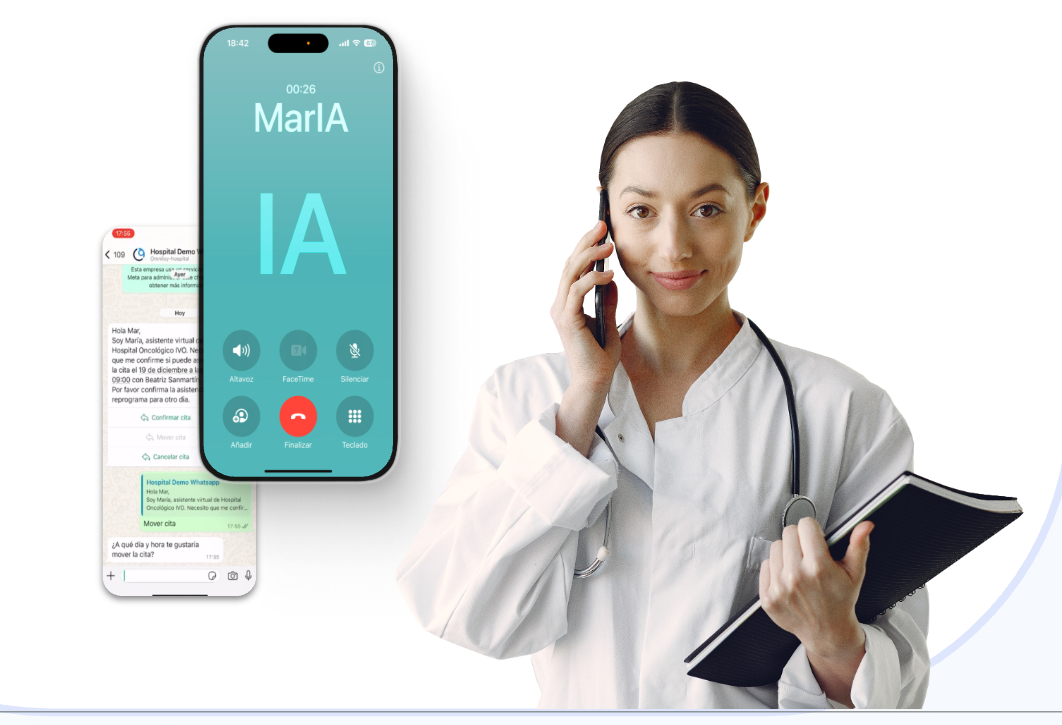
At Omniloy, this is precisely the challenge we address with MarIA, our AI agent for patient service and management. MarIA enables the automation of voice and WhatsApp conversations, integrating with the centre’s systems to support processes such as appointment management, confirmations, reminders and other administrative tasks.
The goal is not simply to answer more calls, but to help more tasks reach completion without adding unnecessary work for admissions and patient service teams. And to do so while maintaining three fundamental principles:
- Integration: work with existing systems and the operations enabled at each centre.
- Security and control: verify identity where appropriate, protect patient data and respect the rules governing each action.
- Continuity of care: make human intervention available when needed, without turning automation into a barrier.
Not every call should end with an automatic action. That, too, is part of a good experience.
What if the patient wants to speak to a person?
There are situations in which the best response from AI is knowing when someone from the team needs to step in.
The patient may be unable to verify her identity. The task may fall outside the permitted conditions. A clinical question may require professional assessment. Or she may simply prefer to speak to a person.
A good agent should not turn that request into an endless succession of automated responses. It should make it easy to transfer the call to the right team, sharing the necessary context while respecting the centre’s privacy requirements. And when no staff are available, it should say so transparently and offer the authorised alternatives.
AI should not replace the possibility of receiving human care. It should help make that care available where it adds the most value.
Fewer unresolved calls. More completed tasks.
How do we know whether an AI agent is working well? Counting answered calls is a start, but it does not explain the impact of automation on its own.
Imagine two scenarios:
In the first, an agent answers 1,000 calls, correctly identifies the requests and transfers most of them to administrative teams.
In the second, it answers the same 1,000 calls, but also manages to complete a significant share of authorised tasks directly in the hospital’s systems.
Both have automated the initial response. But their operational impact is very different.
That is why, alongside call volumes, it is essential to measure indicators such as:
- Effective resolution: the percentage of eligible tasks completed and verified in the system.
- Reduced administrative work: tasks that no longer need subsequent manual intervention.
- Patient experience: the time and effort required to complete a task.
- Appropriate escalation: requests reaching the right human team, with the necessary information.
- Operational quality: changes recorded correctly, without errors or repeat contacts.
There is an important nuance: transferring a call does not always mean that automation has failed. If the situation requires human judgement, an appropriate transfer is also a good outcome.
Success is not about avoiding all human intervention. It is about automatically resolving what can be resolved and making the rest easier, without adding friction.
Transformation does not start by replacing the whole switchboard
For a hospital, introducing AI agents does not have to mean transforming every service channel from day one. Often, the best starting point is much more specific. A frequent task. A well-defined process. An integration with the existing system. A clear set of rules and exceptions.
For example, start by automating certain appointment changes and assess how many are completed correctly, how much work is avoided and how the patient experience improves. Then gradually expand the scope.
Because the most important question is not:
“How many calls can our AI answer?”
It is:
“How many of our patients’ needs can we resolve better?”
The best AI is the one that stops being the main character
Let us return, one last time, to the patient who needed to change her appointment. She does not know which AI model answered her call. She knows nothing about the HIS integrations or the rules the system applied. And she does not need to know.
She only knows that she called, explained what she needed and managed to change her appointment. For her, it was a simple task.
For the hospital, it may mean one less administrative task, more capacity to deal with complex situations and a smoother patient experience.
The real advance is not getting patients to talk to artificial intelligence. It is making sure they do not have to call twice to resolve the same thing.
MarIA does not automate conversations for the sake of it. It turns patients’ needs into real, integrated, secure and completed tasks, with human support when needed.
What if your patients could complete more tasks in a single call?
Discover how Omniloy’s MarIA can help transform patient services through AI agents integrated with your centre’s systems.