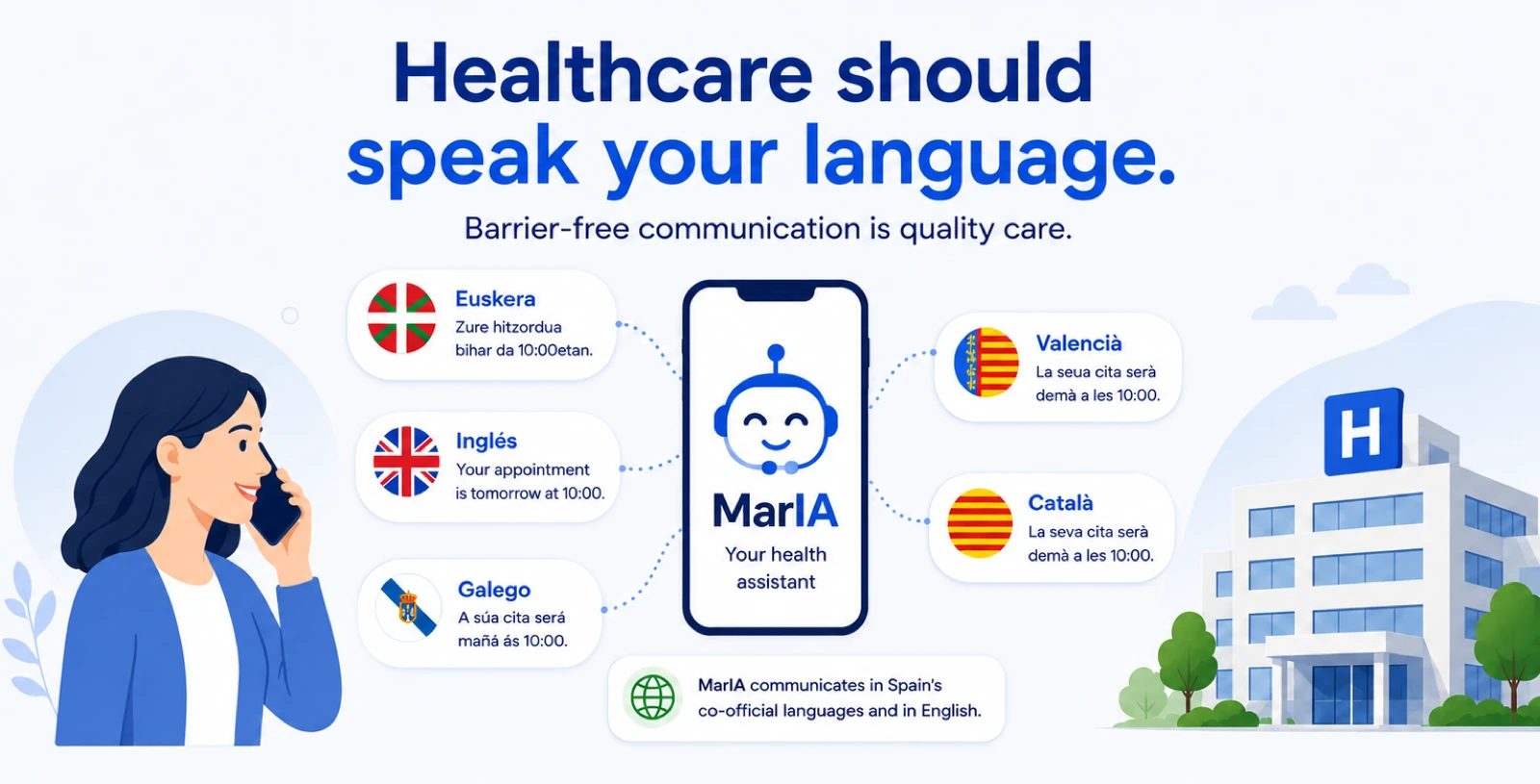
In healthcare we take it for granted that everyone understands the instructions: how to prepare for a test, when to take each medication, what that message from the hospital actually means. But for many people, that understanding is not automatic. An elderly person more comfortable in Galician than in Spanish. A migrant who doesn't master the language yet. Someone who, with the nerves of a hospital phone call, catches only half of what they are told.
When language becomes a barrier, it is no minor inconvenience. It can be a health risk.
Not an isolated case: an entire country
It may look like a problem affecting a few, but the figures say otherwise. According to Spain's National Statistics Institute (INE), the foreign-national population in Spain has reached 6.34 million people, already 13.1% of the total population. Add to that the tourists who may need care each year, and the co-official languages that coexist within the country itself.
In any health centre, every day, there are people receiving information about their health in a language that is not the one they understand best. It is not an exception: it is part of the everyday landscape of healthcare.
How it is solved today, and why it isn't enough
Centres aware of the problem do what they can: intercultural mediation services, telephone interpreters, staff who lend a hand when they speak the language. These are valuable and necessary initiatives, but they share one limit: they depend on someone being available, at the right moment, for the specific language needed.
An interpreter cannot be in every consultation at once, nor at eleven at night, nor for the dozens of languages that may walk through a hospital door.
Speaking the patient's language, literally
If we want technology to improve healthcare, it first has to be able to communicate the way people do: in the language each patient understands. That is why, when we thought about how MarIA should communicate with patients, one thing was clear: technology has to adapt to the person, not the other way around. And adapting includes something as elementary as speaking to them in their own language.
MarIA communicates in 72 languages, including Spain's co-official languages —Galician, Catalan, Basque and Valencian—, both by phone and via WhatsApp. Because we know that speaking the patient's language is not a convenience. It is how you guarantee that information arrives complete to people who would otherwise be left halfway. Technology makes that capability scalable. What once depended on finding the right person at the right moment can now be available to any patient, at any time.
MarIA ensures care 24 hours a day, without depending on additional resources, on an interpreter being available, or on a professional who happens to speak that language.
The impact goes well beyond efficiency. When a patient understands the instructions they receive, treatment adherence increases, errors decrease, and their experience of the health system improves.
Accessibility is also about understanding
When we talk about accessibility we usually think of physical barriers. But there is another one, just as important: understanding the information about our own health. Being able to do so in the language we understand best is accessibility too.
And it is one of the things that technology, well designed, can solve at scale. It does not replace human mediation where that is irreplaceable, but it can guarantee a common floor: that nobody is left without understanding the basics simply because of the language they speak.
Nobody should receive worse care for not being fluent in the administrative language of their hospital. Technology speaking their language is not a luxury: for many patients it is the difference between understanding their treatment and following it blindly.
The best healthcare begins long before treatment, because the first condition for caring well for a person is that they can understand what affects their own health.
Want to see how MarIA can communicate with your patients in their own language? Talk to our team.